
How Home Health Aides Support Alzheimer’s Patients: A Day in the Life
When a loved one is diagnosed with Alzheimer’s, the world can feel like it’s shrinking. Familiar tasks become confusing, and the home—once a place of total comfort—can become a source of anxiety.
For families in New Jersey, a Certified Home Health Aide (CHHA) does more than just "help out." They are trained specialists who use specific behavioral techniques to turn a day of potential confusion into a day of structured, peaceful engagement.
Here is how professional memory care at home changes the daily experience for Alzheimer’s patients and their families.

1. Creating a "Frictionless" Morning Routine
For someone with Alzheimer’s, the morning sets the tone for the entire day. A sudden wake-up or a rushed breakfast can trigger agitation that lasts until sunset.
The Vitality Approach: Our aides start the day with "Validation." Instead of correcting a confused thought, they meet the patient where they are.
The Routine: They assist with a slow, dignified grooming process, breaking down tasks like brushing teeth into "one-step" instructions to prevent overwhelm.
2. Managing "Sundowning" with Environmental Cues
Many families in Essex County and Passaic County call us because of "Sundowning"—the increased confusion and restlessness that occurs as the sun sets.
Lighting Control: At dusk, our aides close the curtains and turn on warm, bright indoor lights to eliminate the shadows that often cause hallucinations or fear.
Calming Activities: Rather than a loud evening news program, an aide might introduce soft music or a simple, repetitive task, such as folding warm towels, which provides a sense of accomplishment and calm.
3. Proactive Wandering Prevention
Wandering is one of the greatest fears for Alzheimer’s caregivers. According to the Alzheimer's Association, 6 in 10 people living with dementia will wander at least once.
Identifying Triggers: Aides are trained to notice the signs of "exit seeking." Is the patient looking for a coat? Are they pacing near the door?
Redirection: Instead of saying "You can't go outside," an aide might say, "I was just about to make some tea, would you help me pick out the mugs?" This redirects the impulse to leave toward a safe, indoor activity.
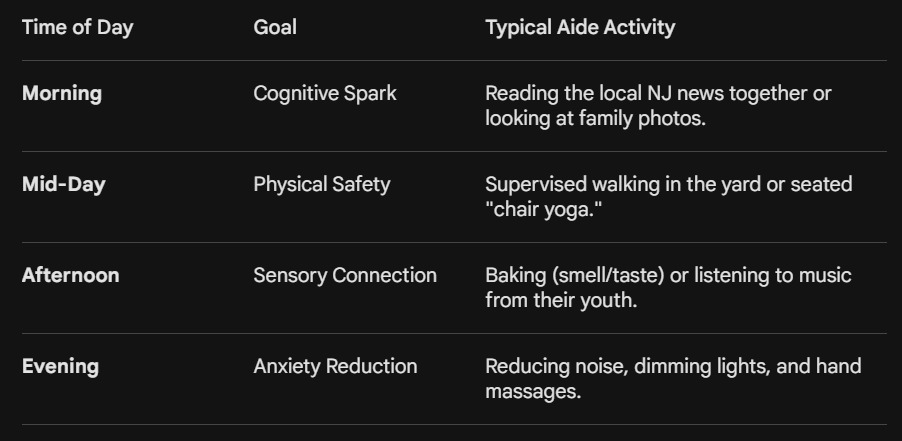
The Alzheimer’s Daily Engagement Matrix
Our aides don't just "watch" a patient; they engage them based on their current cognitive strength.
4. Nutrition and Hydration: The "Hidden" Challenges
Alzheimer's patients often forget to eat or lose the ability to recognize thirst.
Visual Cues: Aides use high-contrast plates (like a bright blue plate for white mashed potatoes) so the patient can clearly see their food.
Hydration "Snacks": They provide water-rich foods like melon or cucumber throughout the day to help prevent UTIs, which frequently cause sudden "delirium" in dementia patients.
5. Medication Reminders and Safety
While a CHHA in New Jersey cannot administer medication (that requires an RN or LPN), they are vital for medication reminders. They ensure the patient takes the right pill at the right time, preventing the dangerous double-dosing that can happen when memory fails.
Conclusion: Turning "Caregiving" Back Into "Family Time"
When you hire a specialist to handle sundowning, wandering, and hygiene, your role changes. You are no longer the "policeman" or the "janitor"; you get to be the son, the daughter, or the spouse again.
At Vitality Health Care, our Alzheimer’s-trained aides bring a "Standard of Heart" to every home. We serve families across Northern and Central New Jersey, providing the specialized support that turns a difficult diagnosis into a manageable journey.
Is your loved one’s routine becoming unmanageable?
You don't have to wait for a crisis to get help. Speak with an Alzheimer’s Care Specialist today to see how a structured daily plan can restore peace to your home.
